



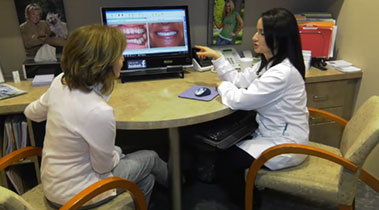

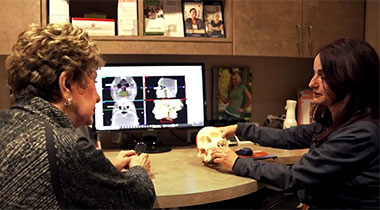





"I was immediately confident with Dr. Barbat. She explained everything that was happening in my mouth. My smile before wasn’t as cheerful as it is now. I just didn’t give a full smile. Now, I smile more and larger. I would do it all again if I had to!"
- Joan Manor
"Very happy to have discovered Dr. Barbat for myself and my 86 year-old Mom. Mom has struggled for years with ill-fitting dentures. Dr. B is turning that around, with 2 implants & new dentures for Mom, that will, at long last, allow her to chew normal foods again. For myself, I was given an initial cleaning & "dental roadmap" for things I need to be aware of that could present future problems. I was also given some options to think about & the evaluation for sleep apnea was unexpected but invaluable! I really appreciate the thorough, kind, professional, & holistic approach that Dr. B & her staff take. I look forward to a long smiling relationship with the office!"
- Kathy
"As always my cleaning experience was wonderful. Very friendly, and comfortable. I no longer dread having my teeth cleaned."
"Dr. Barbat is true to her word with painless injection. There we no pain or discomfort during the injection nor during the procedure. The staff are some of the most friendliest people I have ever met and make you feel like you're friends and not a patient. I would highly recommend Dr. Barbat and her services to everyone."
|
|
is to give comprehensive care so patients can enjoy the benefits of optimal oral health and appearance;
to offer an environment where patients receive exceptional skills and technology, the highest standard of care, compassion and respect; and
where a dedicated team is focused on providing meticulous patient care with every visit.
This is
Where Lasting Smiles Begin |
|

Dr. Ban Barbat |
Healthy teeth and gums give smiles that last a lifetime.
For a stress-free mouth, Preventive Care Appointments protect your oral health and appearance and help you avoid treatment. In addition, a full range of services are available to help you and your entire family enjoy the confidence and comfort of a healthy smile.
Typical hygiene appointments include...
- Thorough cleaning and flossing
- Full-mouth dental and periodontal (gum) exam
- Oral cancer screening
- Periodic radiographs (X-Rays) to detect decay, bone loss or tumors
- Consultation and recommendations
If risk factors are present, Dr. Barbat will develop a treatment program to restore your mouth to a healthy state.
Periodontal (Gum) Therapy
Sore, bleeding gums, bad breath, or receded gums may indicate Periodontal Disease. Eventually, tooth loss occurs. Research has linked gum disease to heart disease, low birth weight babies, stroke, and diabetes. Dr. Barbat provides non-surgical therapy to successfully treat most stages of gum disease.
Your child’s smile is precious. His or her ability to enjoy a healthy smile and a lifetime of natural teeth begins at home. By helping your son or daughter to develop good oral hygiene into their daily routine at an early age, you are giving them a smile that will last a lifetime!
By your child’s first birthday, teeth have already begun to emerge. This is the best time to have your child evaluated. Dr. Barbat can check for signs of decay or jaw irregularities that may contribute to future problems. By detecting problems early, your child can often be prevented the need for more extensive care.
It is wise to get your child accustomed to a daily regimen of brushing and flossing. Before the age of four, your child will need help to do this. Here are some guidelines that will make the process easier for you and more pleasant for your child.
BRUSHING TECHNIQUE: In order to get good access to the outside of the teeth and gums, gently use your first two fingers to retract the lips. When doing the inside areas, you can carefully use your index finger to keep the tongue out of the way.
Brush gently, moving the brush in small circles where possible. Finish each circle before moving on to adjacent teeth, overlapping the circles.
A good sequence to follow is to brush:
- Outside top, then outside bottom
- Inside top, and then inside bottom
- Next, move to chewing surfaces and brush in a back and forth motion.
- Equally important are surfaces are those between any missing teeth.
- Make sure that the bristles of the brush reach those areas.
FLOSSING: Brushing does not reach areas between teeth that are contact. These areas need proper cleaning as much the other surfaces. As with brushing, a flossing sequence and technique will help create a comfortable and easy process.
Start with about 18 inches of dental floss material. Wrap about half of it around each of your middle fingers. Leave about six inches unwound between your fingers. Use your forefingers to guide the floss, keeping the forefingers about an inch apart on the floss material.
Gently move the floss up and down between all teeth two or three times, following your chosen sequence. For example, right to left on top, then right to left on bottom. Use a back and forth motion from top to bottom, alternatively pulling the floss toward each adjacent tooth. Rapid up and down snapping and too much forcefulness can damage gums.
The floss you are using will become frayed or dirty. When it does, simply roll one turn from finger to finger to get a fresh section of floss.
HAVING YOUR CHILD TAKE OVER: By the age of four, your child should be ready to assume some responsibility for brushing. Your patience, assistance and inspection will be necessary for some time. Monitor your child to make sure he or she does not swallow excessive amounts of tasty toothpaste, which can lead to tooth discoloration.
This investment of your time now will help to create a lifetime of confident smiles!
Chances are, if you suspect your breath is bad, it probably is. Daily brushing, flossing, and swishing with an antibacterial rinse can decrease the development of oral bacteria. However, it is this bacteria that contribute to bad breath and some adults are more susceptible than others.
If breath odor is unpleasant just at certain times of the day, there are convenient ways to freshen-up. Food particles caught between teeth can cause bad breath odor in just a few hours. Naturally, the best recommendation is to brush your teeth and tongue after eating. More convenient options include swishing or chewing sugarless gum. Yet, unlike food odors, odor from the sticky film and plaque in the mouth is not easily removed.
Dry mouth can also contribute to bad breath. While the natural aging process decreases the flow of saliva, some medications have a drying effect as well. This contributes to bad breath since there is insufficient saliva to move bacteria out of the mouth. Oral rinses to replenish moisture in the mouth are readily available. Nasal sprays are also available over-the-counter to help combat odor that may be sinus related.
Adults with higher vulnerability to bacteria need dental hygiene visits more often than every six months. Although many don’t associate persistent bad breath as a symptom of gum disease, a thorough oral examination may reveal this as the culprit. Bad breath, which results from gum disease bacteria, causes far greater problems when untreated.
Seventy-five percent of American adults over age 35 have some form of periodontal disease; the number one cause of tooth loss. Because this disease begins silently, like other diseases that form in the body, you may not suspect it in its initial stage. Once symptoms emerge, such as bad breath, bleeding gums, soreness in the mouth, and gum recession, these problems are often assumed to be temporary, allowing the disease to progress further.
Research has found that these bacteria can enter the bloodstream and travel to other parts of the body. Links to major health problems such as coronary artery disease, stroke, diabetes, memory loss, preterm babies, and lung disease have been found. Any infection, such as an abscess, can contribute to unpleasant breath odor and make you more susceptible to continuing repercussions from bacteria. A thorough dental exam can reveal that problem.
Your breath odor may be a warning that bacteria in your mouth of bacteria can eventually cause devastating harm to your teeth, gums, and general health. Early treatment can help to eliminate problem; usually with no lasting repercussions.
Dr. Barbat and her team of Registered Dental Hygienists structure regular dental check-ups to help each patient maintain good oral health. A thorough periodontal examination and cleaning on a regular basis can help you feel more confident with your breath and enhance your overall health as well.
PROTECTIVE MOUTHGUARDS
The American Dental Association advises wearing mouthguards for children and adults in most recreational activities to cushion blows that could cause broken teeth and injuries to the lips, tongue, face or jaw. It is believed that they can also reduce the severity and incidence of concussions.
There are several types of protective mouthguards. While "boil-&-bite" types do not require a dental fitting, the most comfortable are custom-made. Dr. Barbat can also make mouthguards for lower teeth, which are equally vulnerable to damage.
MOUTHWEAR FOR A COMPETITIVE EDGE (Click here to learn more)
In addition to protective mouthguards, Dr. Barbat also offers performance-enhancing mouthwear for non-contact sports. Both the Pure Performance Mouthguard and the ArmourBite Mouthwear are designed to unlock your body’s instinctive reflex system – teeth clenching – to give you an athletic edge, from running to golf to tennis or nearly any sport.
In sports, the natural reaction is to clench the jaw. This compresses the TMJ (jaw joint), which releases excess performance-sapping hormones (like cortisol) to produce stress, fatigue and distraction. Dr. Barbat explains, "When you prevent your teeth from clenching and pivot the jaw forward, you relieve pressure on the jaw joints and eliminate excess negative hormones and energy-draining effects so you can achieve your full athletic potential."
TOOTHACHE
Clean the area around the sore tooth thoroughly. Rinse the mouth thoroughly with warm, salt water or use dental floss to gently dislodge trapped food or debris. If the face is swollen, apply a cold compress. Take acetaminophen for pain and see a dentist as soon as possible. Do not place aspirin on the gum or the aching tooth.
CUT OR BITTEN TONGUE, LIP OR CHEEK
Apply cold compress to bruised areas. If there is bleeding, apply firm but gentle pressure with a clean gauze or cloth. If bleeding does not stop within 15 minutes or cannot be controlled by simple pressure, take the child to a hospital emergency room.
KNOCKED OUT PERMANENT TOOTH
Handle the tooth by the top portion rather than the root. Rinse the tooth, but do not clean or handle the tooth unnecessarily. Try to reinsert the tooth into the socket and have the child hold the tooth in place by biting on a clean gauze or cloth. If you cannot reinsert the tooth, place the tooth in a cup of milk or water and see a dentist immediately. Time is a critical factor in saving a tooth.
BROKEN TOOTH
Rinse dirt from injured area with warm water. Place cold compresses over the area of the injury. Save any broken tooth fragments and see a dentist immediately.
POSSIBLE BROKEN JAW
If a fractured jaw is suspected, use a tie, towel or handkerchief to tie underneath the chin and over the top of the head. This will help to keep the jaws from moving. Take the child to the nearest emergency room.
BROKEN BRACES & WIRES
Fortunately, most loose or broken appliances do not require emergency room attention. If the appliance can be removed easily, take it out. If not, cover sharp or protruding portions with cotton balls, gauze, or chewing gum. If a wire is stuck in the gums, cheek, or tongue, do not remove it. Take the child to the dentist immediately.
BLEEDING AFTER BABY TOOTH FALLS OUT
Pack the bleeding area with a folded, clean gauze or cloth. Have the child bite on this with mild pressure for 15 minutes. Repeat for another 15 minutes if necessary. If bleeding persists, see a dentist immediately.
Do you have a Canker or Cold Sore? If the sore is location inside your mouth, it's most likely a canker sore. If it’s on the outside, it is probably a cold sore.
Canker sores (mouth ulcers) generally occur inside the mouth and are bacterial in nature. They often are triggered by trauma such as biting your cheek, jabbing your gum with your toothbrush or even overzealous tooth cleaning.
Cold sores are tiny, clear, fluid-filled blisters that form around the mouth and are caused by the herpes simplex virus living inside your nerve tissue. (It is not the same virus that causes genital herpes.)
| | |
| Where does it strike? | Outside the mouth | Inside the mouth |
| What does it look like? | Tiny, clear fever blisters usually | Small ulcer with a white or gray on the lips or under the nose base and red border |
| What triggers it? | Flare-up of herpes simplex virus | Trauma-Biting your cheek or jabbing gum with toothbrush |
| How long does it last? | About a week | One or two weeks |
| Is it contagious? | Yes | No |
| How do I treat it? | Aloe Vera or over-the-counter topical anesthetics to cut pain and discomfort | Rinse with antimicrobial mouthwash or warm water and salt |
| Over-the-counter medications or, drugs to prevent outbreak if needed, prescription antiviral | Over-the-counter oral anesthetics |
|
|